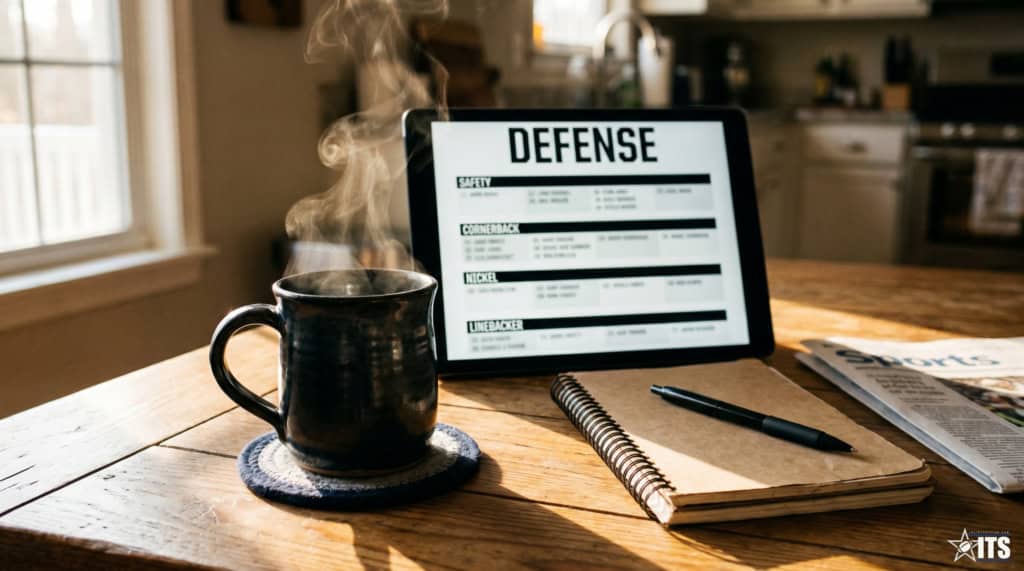
Sunday afternoons in North Texas in 2026 still begin the same way they did a decade ago. Coffee, depth charts pulled up on a tablet, group chats lighting up with playoff math even when it is May, and that quiet ritual of spreading out the week’s notes across a kitchen table while the pregame show talks over itself in the background. What has changed is what fans bring to that table.
The Dallas Cowboys closed last season as one of the most-watched franchises on the planet, with annual revenue topping $1.2 billion according to Forbes estimates, and the audience that follows them has become noticeably more analytical.
Fans now compare snap-count tables the way scouts compare wide-zone tape, and they do the same thing with the platforms they use to stake an opinion on a game. The standard pitch from any operator, the kind that worked in 2018, no longer survives a second cup of coffee in a Cowboys living room.
What follows is not a checklist of brand names or a glossy promotional reel. It is a Cowboys-first reading of the 2026 NFL landscape, with a side question running through it.
As the league grows louder and the salary cap climbs past $300 million for the first time, what does it actually mean for a fan to vet a platform the same way Brian Schottenheimer’s staff vets a fourth-round cornerback?
The pieces below walk through the Cowboys’ offensive line, the rookie defensive backs, the NFC East’s revised pecking order, the divisional schedule, and the broader business picture, and they fold in the platform-vetting question where it naturally fits, because in 2026 the two conversations belong on the same page.
The discipline that Cowboys fans bring to a Christian Parker zone-coverage debate is the same discipline they now bring to comparing operators on the open market. Anyone who looks for gambling sites in 2026 expects what Gaming Today calls the boring stuff to be done first: clear payout track records, real licensing posture across multiple states, transparent terms on welcome offers, and a customer-service paper trail that holds up when the chat window is busy on a Sunday at one in the afternoon.
The rest of this article keeps its eye on the football, where it belongs, and treats the platform question the way an NFL evaluator treats a free-agent visit, with a checklist and a stopwatch.
Where the Cowboys Roster Actually Stands Heading into 2026
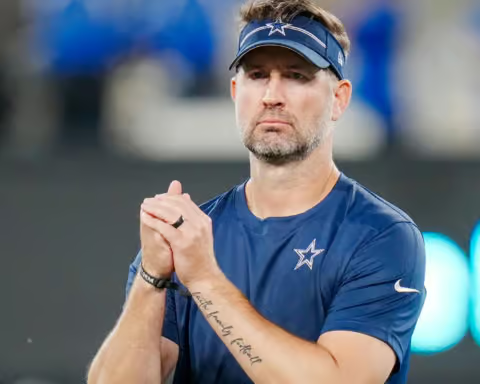
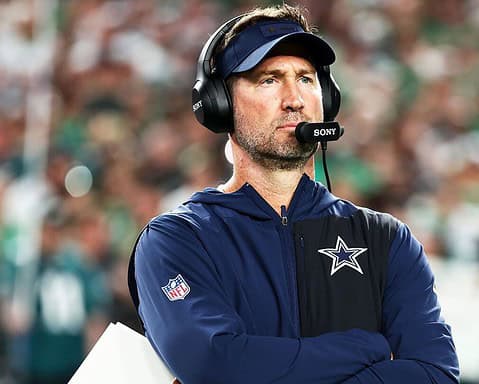
Brian Schottenheimer enters his second offseason as head coach with a roster that looks measurably different from the one Mike McCarthy left behind.
The 2026 draft brought seven new names into Frisco, and three of them are likely to be on the field for opening kickoff. Caleb Downs, the former Ohio State safety taken 11th overall after a trade-up from 12, projects as a three-position chess piece who can play deep, drop into the slot, or rotate into a nickel role that defensive coordinator Christian Parker has already flagged as the biggest need on the team.
The second first-round pick, Malachi Lawrence, the UCF edge taken 23rd, slots into a rotation behind Rashan Gary and second-year edge Donovan Ezeiruaku, the pass rush Dallas has been rebuilding since shipping Micah Parsons to Green Bay last summer.
Round three brought Jaishawn Barham from Michigan to plug the inside linebacker hole unfilled since Eric Kendricks left, round four delivered Drew Shelton, Devin Moore, and LT Overton, and round seven added speed receiver Anthony Smith out of ECU — six players whose college tape suggests they will not be ceremonial roster spots.
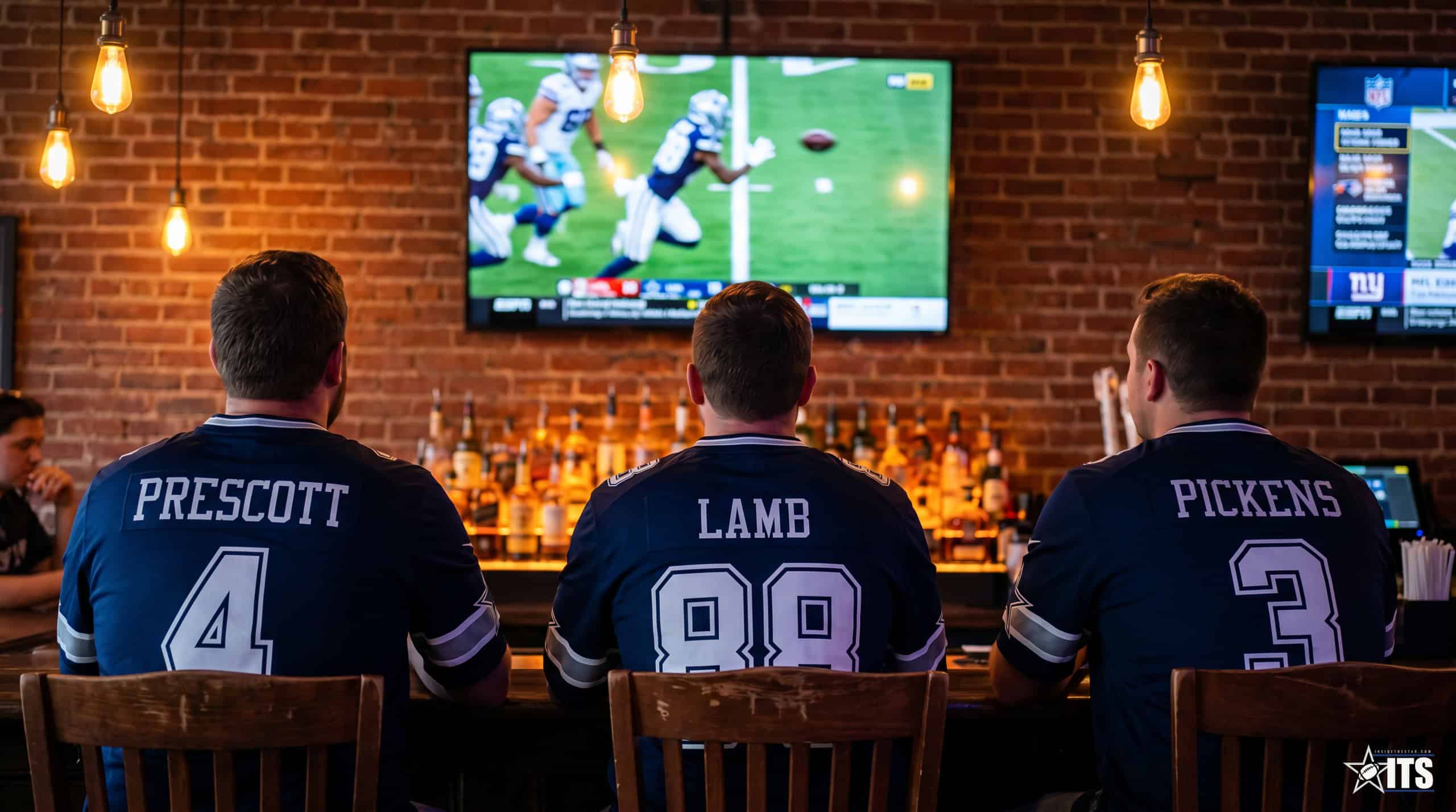
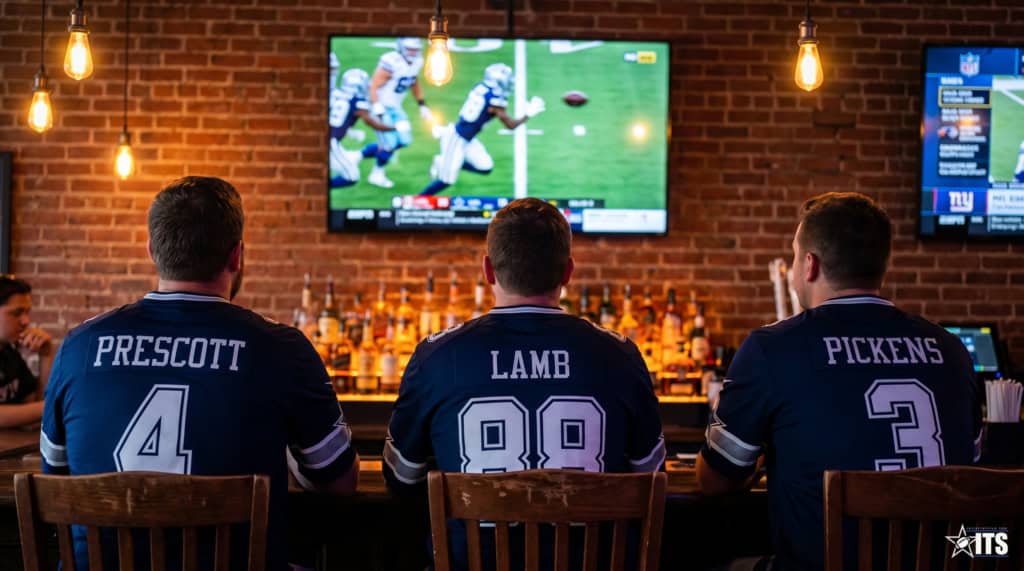
The free-agency board added safeties Jalen Thompson and PJ Locke for veteran cover, and the receiving room behind CeeDee Lamb includes George Pickens after a trade last year that cost a third-round pick.
The picture is busier than it has been in years, and it is the kind of roster a fan can study with a stat sheet rather than a highlight reel.
The Offensive Line Question That Will Decide the Season
Tyler Guyton enters his third season at left tackle with the franchise’s protection plan resting on his shoulder pads. The 2024 first-round pick has shown enough flashes to keep the projection optimistic, but he has also missed time in each of his first two seasons, and the depth behind him has been a work in progress.
Terence Steele, who reworked his contract this spring, holds the right side. Nate Thomas remains the swing tackle. Drew Shelton was added in round four with 34 college starts at Penn State across both tackle spots, and the early read inside the building is that he will compete for swing-tackle reps and, if Guyton misses time again, push into the starting lineup faster than a typical fourth-round pick.
The interior is steadier. Cooper Beebe at center, Tyler Booker at left guard, and Brock Hoffman as the primary swing piece give the line a recognizable identity.
The Cowboys have committed almost 30% of their projected cap to the line in 2026, and Schottenheimer has been candid that the offense will only travel as far as that group can take it on third-and-five.
For fans, the offensive line is the position group most worth watching all summer, because no other unit on the roster carries this kind of leverage on the season’s outcome.
What Caleb Downs and the Rookie Secondary Actually Change
Christian Parker arrived from a defensive staff that built its identity around sub-package snaps, and the early signs from organized team activities suggest he is going to push that identity onto the Dallas defense from day one.
Caleb Downs is the obvious building block. Ohio State used him in three roles in 2025, and Parker is on record describing the rookie as a piece who can play single-high, two-high split, slot, or even the dime linebacker spot in heavy passing situations.
Devin Moore, the Florida cornerback taken in round four, was clocked at 4.50s at the combine and brings the long-arm press that the room was missing after Trevon Diggs’s lost season.
Behind them, Jalen Thompson and PJ Locke add veteran range.
The biggest functional change is that Parker can now field a five-defensive-back package without sacrificing run defense, because Downs at 206 pounds can fit and tackle in the box.
That capacity matters in a division that pairs Jalen Hurts’s option game with Daniel Jones’s improvisations and Jayden Daniels’s quick-release attack, three quarterbacks who punish a slow-rotating secondary in different ways.
Reading the Cowboys Defense Projection from a Fan’s Vantage Point
The numbers from last season are the part nobody on the staff wants to revisit, and they are the part every honest projection has to start from.
Dallas finished bottom-third in yards allowed per game and gave up explosive plays at a rate that does not square with a franchise of this revenue base. Cody Warren’s Cowboys defense projection for 2026 walks through the floor and the ceiling for the unit using last year’s snap counts as the baseline, and his read is sharp on what an honest improvement curve looks like for a defense breaking in three rookies and a new coordinator.
The takeaway from a fan’s vantage point is that progress will not arrive in a single week.
Schottenheimer has said as much in interviews. The unit will look uneven through the first month, and the real evaluation point is the Thanksgiving game, by which time Parker will have run his sub packages against a real cross-section of NFC offenses.
Anyone projecting Dallas back into the playoffs is implicitly projecting that this defense reaches league-average by mid-November, and that hinges as much on Parker’s coaching as it does on Downs’s snap distribution.
The NFC East Pecking Order After the 2026 Draft
The Eagles still hold the divisional crown until somebody takes it from them, and Howie Roseman’s draft class did nothing to make that task easier. Philadelphia traded up three spots with the Cowboys on day one to take USC receiver Makai Lemon at 20, adding the Biletnikoff Award winner to a passing offense built around DeVonta Smith.
The Giants entered with seven picks and spent both top-10 selections rebuilding around second-year quarterback Jaxson Dart, taking Ohio State linebacker Arvell Reese at five and Miami offensive lineman Francis Mauigoa at 10.
Washington finished third in the division last year and used the seventh-overall pick on Ohio State linebacker Sonny Styles, then added two weapons for Jayden Daniels later in the draft with Clemson receiver Antonio Williams in round three and Penn State power back Kaytron Allen in round six.
The Cowboys’ draft was the most aggressive of the four, with two first-round picks earned through the trade up for Downs, and the most aggressive draft does not always translate to the best division finish.
The honest read after May is that this is a two-team race, with Dallas chasing Philadelphia, and the coming matchups in weeks one and seven will set the tone before October’s bye. Fans who want to handicap the division should anchor on those two games, plus the late-November home game against Washington.
What the NFL’s Money Curve Actually Means for the Audience in 2026
Inside The Star is a fan-first publication, and the business of the league usually sits in the background. It is worth surfacing for one paragraph, because the 2026 numbers are the reason the on-field product looks the way it does.
The salary cap is set at $301.2 million this season, up from $279 million last year, and that figure is itself nearly double what it was in 2015. The Front Office Sports decade revenue review walked through the full 10-year arc earlier this winter, and the through-line is that media-rights renewals, sponsorship growth, and international expansion have rewritten the league’s economics in a way that ripples directly into roster construction.
Sponsorship revenue alone hit $2.7 billion in 2025, an eight-percent climb, with financial brands and technology categories driving the growth.
For Cowboys fans, that math is the reason Jerry Jones can spend on players like Pickens (franchise tag) and Quinnen Williams (trade) without flinching, and it is the reason the front office can absorb a Brandon Aubrey contract that made him the highest-paid kicker in NFL history.
The league’s money curve is also the reason every off-field service that markets to NFL audiences, from streaming bundles to fantasy platforms to operators offering odds on every prop, has had to raise its game.
The audience is more sophisticated, and the audience expects more in return.
The Vetting Habits Cowboys Fans Have Learned from Watching the Front Office
There is a reason Cowboys fans speak fluent salary-cap math at the dinner table, and it is the same reason they are unusually careful when they evaluate any consumer product that asks for their money on a Sunday morning. Watching a front office work cultivates a certain skepticism.
You learn to ignore the splashy press release and look at the per-snap value. You learn to ignore the marketing line about a player’s measurables and pull the tape from his three best opponents. You learn to read a contract for the language that bites when something goes wrong. That skepticism transfers neatly to the platform-vetting question.
A 2026 Cowboys fan does not click on the first banner that rolls past during a third-quarter timeout.
They check whether a platform is actually licensed in the states where they live or travel. They check the public posting of payout speeds. They look up customer-service response windows during peak Sunday hours, when twenty other people are also trying to reach support before the late window kicks off.
They keep a separate inbox for promotional emails, the same way they keep a separate folder for Cowboys depth-chart updates from the team beat. The discipline is identical, and the operators that have figured this out are the ones surviving the 2026 audience.
Three Cowboys Storylines That Will Carry the 2026 Schedule
The schedule release in May leaked the rough shape of the season, and three subplots will carry the year. The table below puts them in plain terms, because every fan deserves a one-page summary they can keep in the kitchen drawer through training camp.
| Storyline | Where it lives on the schedule | Why it carries the year |
| The Pickens-Lamb pairing | Weeks 1, 6, 11 against pass-stop defenses | Two alpha receivers in Schottenheimer’s system, and the play-action map needs both for the offense to climb into the top-five |
| The Christian Parker stress tests | Weeks 4, 8, 13 against Hurts, Allen, Mahomes | The first real evaluations of the rookie-heavy secondary against the league’s three most accurate quarterbacks |
| The September road slate | Weeks 2 and 3 in Atlanta and Chicago | Two warm-weather and one cold road game in the first month set the early-season tone before the Thanksgiving showcase |
These three threads will shape every weekend conversation in the bars on lower Greenville and along Henderson Avenue from September through January. They are also the threads that will dictate what fans actually want from any second-screen service running alongside the broadcast.
A platform that helps a fan track the Pickens-Lamb target share in live time will earn a return visit. A platform that buries that information under five layers of promotional banners will not.
The audience in 2026 has options, and it is exercising them with the same fluency it brings to a snap-count debate.
What the Audience Actually Wants from a Sunday Service in 2026
The audience has done the math. Cowboys fans, and the broader NFL audience that has watched the league grow into a $23 billion business, have stopped accepting the standard pitch from any service that asks for their attention on a Sunday.
They want clarity on terms before they sign up, not after. They want fast, native customer service when something does not behave the way the marketing said it would. They want pricing that does not require a magnifying glass to compare against the competition, and they want a track record that survives a quick Google search.
The same vetting habits that made Jerry Jones’s front office look paranoid in 1989 and visionary by 1993 are now in the hands of the audience, and the audience is using them.
For the on-field product, that audience is a gift. It rewards substance, it punishes shortcuts, and it shows up every Sunday with notes.
For the platforms that operate around the league, the lesson of 2026 is the same one Brian Schottenheimer tells his rookies in May. Earn the snap before you ask for the role.
The fan in section 245 has been watching the tape, and the fan in the den has the remote in one hand and the depth chart in the other, and neither one of them is impressed by anything that does not survive a second look.
Was this helpful?