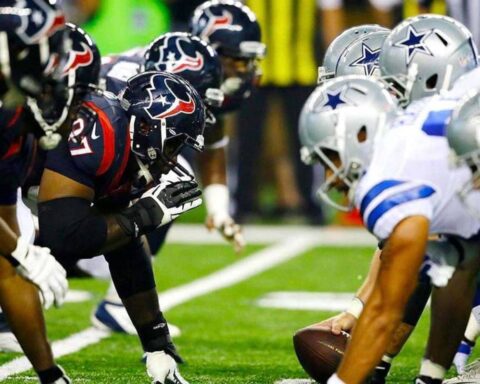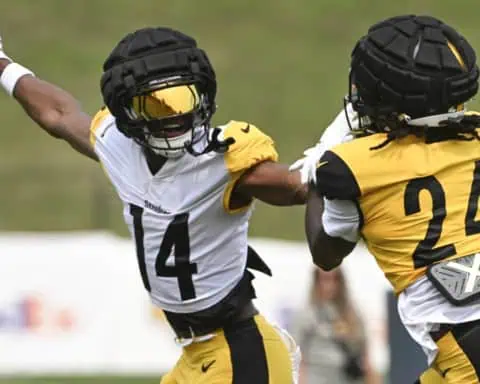
Dallas walked out of 2025 at 7-9-1 with the second-ranked total offense in the league and a defense that gave up explosive passing plays at a near-historic rate.
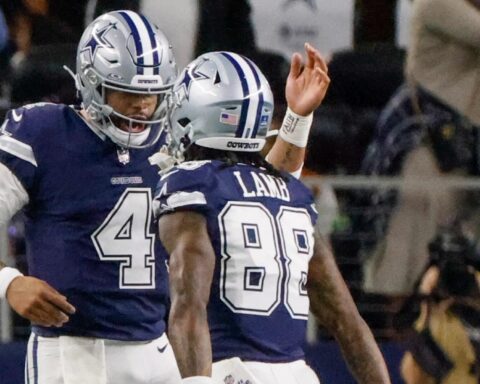
Brian Schottenheimer finished his first year as head coach with a roster that scored points in waves under Dak Prescott, leaned hard on the CeeDee Lamb/George Pickens receiver tandem, and ran out of answers on third down.
The 2026 season opens with the same quarterback, a re-tooled defensive staff led by new coordinator Christian Parker, a Pickens contract resolved through the franchise tag, and a schedule that puts the Giants on Sunday Night Football in Week 1 at home.
The conditions for a real jump are present in a way they were not at this point last May, and the building behind The Star has been quietly building toward that jump for the better part of seven months.
What separates this 2026 group from the McCarthy-era rosters that kept stalling out every January is that the talent around Prescott is younger, faster, and more obviously built for the modern NFC East. CeeDee Lamb posted his fifth straight 1,000-yard season despite a high-ankle sprain that cost him three games.
Pickens followed his Pittsburgh form with 1,429 yards and nine touchdowns once Schottenheimer cleared the route tree for him. Tyler Smith and Tyler Booker anchor an offensive line that no longer needs Tristan Wirfs-type miracles to function.
The defense added Jalen Thompson, PJ Locke, and a Rashan Gary trade that moved a first-round pick and a 2027 fourth to Green Bay. The result is a roster that no longer needs the Eagles to collapse, the Commanders to regress, or the Giants to keep being the Giants.
It needs its own moves to land, and the early returns from OTAs in Frisco read as a team that finally agrees on what it is.
A meaningful slice of the Cowboys fan base now follows the team from outside the United States, and the Canadian cohort has had a particularly busy spring as Alberta opened its iGaming and sportsbook market on February 27.
For Cowboys fans in Calgary, Edmonton, and points across the province who used to bet on Prescott props and NFC East futures through grey-market offshore books, the regulated rollout has reshaped how they engage with the season. Alberta DraftKings Review by Legal Sports Report walks through what the new Alberta market launch actually changes for Canadian players, how the operator’s player props and futures menu compares against the same brand’s US offering, and what Canadian residents need to know about deposit methods, account-control tools, and provincial tax treatment.
It is a useful editorial reference for any Cowboys supporter north of the border who wants to understand the regulated market they are now part of, with the rest of this preview returning to where it should be: the football.
Prescott in Year Two of Schottenheimer With a Real Contract Runway
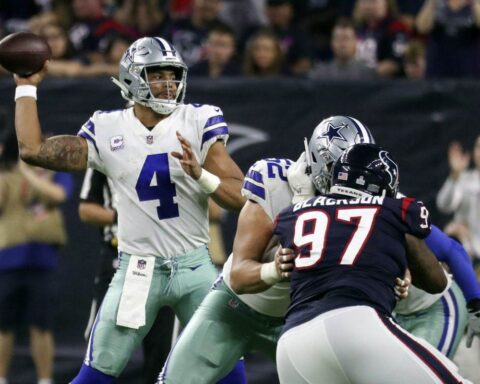
Prescott finished 2025 with 4,552 yards passing, 30 touchdowns, and a 67.3 completion percentage that placed him third in the league among qualified starters.
The interception spike that defined his late October stretch resolved itself in the back half of the year, and the Week 17 performance against Philadelphia in particular gave Schottenheimer the tape he needed to defend the system internally with Jerry Jones.
The contract conversation that dominated 2024 is now behind the building. Prescott’s four-year, $240 million extension runs through 2028 with no-trade language and a fully guaranteed 2026 cap number that gives Schottenheimer a planning horizon his predecessor never had.
The result inside The Star is a quarterbacks room that finally looks settled. Will Grier returned on a one-year deal as the swing arm behind Prescott. Joe Milton entered his second year as a developmental piece with growing optimism from the staff. Quarterbacks coach Steve Shimko has been retained for continuity.
Schottenheimer told reporters in May that the offensive playbook for 2026 expands rather than rebuilds, and the Lamb-Pickens WR1 dynamic gives him room to do that without forcing Prescott into the kind of hero-ball reads that ended a few drives early in November.
What is genuinely new in year two is the situational play menu. The 2026 expansion lives at the goal line and on 2nd-and-long, the two situations where Dallas underperformed expected points added relative to drives that started inside the opposing 35.
Quarterbacks coach Shimko and offensive coordinator Klayton Adams have spent the spring rebuilding the red-zone playbook around Lamb working out of condensed sets and Pickens taking the back-shoulder fade Prescott has historically thrown to a 70 percent completion rate.
None of that is glamorous offseason content, but it is the kind of tweak that turns the 3rd-and-2 from the 17-yard line into a touchdown rather than a field-goal attempt, and the games Dallas lost to NFC East rivals in 2025 came down to exactly that kind of margin.
The Lamb and Pickens WR1 Tandem That Actually Held Up on Tape
The Pickens trade went from “could not work” in February to “became the offense” by Thanksgiving. Pittsburgh sent Pickens to Dallas for a 2026 third-round pick and a 2027 fifth, and the trade became one of the more lopsided moves in the modern Cowboys era.
Pickens led the team in receiving yards, contested catch percentage, and yards after the catch on screens, which was the role nobody on the Dallas staff thought he could play coming out of Pittsburgh.
Lamb finished second on the team in yards but first in targets, first in red-zone looks, and first in third-down conversion rate on receiving plays. The two of them publicly insisted there is no A and no B in the room, and the staff has built the 2026 game plan around that not being a public-relations line but an actual schematic decision.
What makes the WR1 duo durable rather than a marketing exercise is how differently the two receivers force a defense to align. Lamb plays out of the slot in three-receiver packages and motions to the boundary in two-back sets.
Pickens is the X receiver in base personnel and slides into the slot whenever Lamb shifts to a half-back-as-receiver alignment. The result is a coverage puzzle that defenses have to solve pre-snap rather than after the ball is in Prescott’s hands, and the dataset from 2025 suggests defenses simply did not have a clean answer.
George Pickens signed his $27.3 million franchise tag in February while contract talks for a long-term extension continue, and the building has been clear with the cap office that keeping both receivers through 2027 is a top-three roster priority.
The Quarterback Edge Most Outside Analysts Are Underselling
Inside The Star ran the case in early May that Prescott still gives the Cowboys a meaningful positional edge across the league, and the Dak Prescott quarterback edge breakdown walks through why most national outsiders are miscounting where Dallas actually sits at the position. The piece is worth rereading because it isolates the variables that matter most for a 2026 evaluation: completion percentage above expectation in third-down situations, time-to-throw under pressure relative to peer quarterbacks, and the air-yards-per-attempt number that the Schottenheimer system was built around.
The gap between Prescott’s actual production and the consensus public ranking of him is one of the cleaner edges the Cowboys carry into the season.
Dallas plays a schedule that includes six games against the Eagles, Commanders, and Giants, and the underlying numbers say Prescott is the best quarterback on the field in four of those six matchups by a wider margin than the Vegas opening lines have implied.
The Receiver Hierarchy Decision That Defines the Season
The Lamb-Pickens dynamic gets its sharpest reading in a recent piece from the league’s own newsroom, where the NFL.com Lamb Pickens WR1 piece unpacks how both players explicitly rejected the A-B framing during minicamp and what that means for how Schottenheimer calls third-and-long in 2026.
The reporting includes specifics that matter beyond the soundbites: the route tree split, the snap-count overlap, the formation distribution by personnel package, and the deliberate way the staff has been training both receivers to play out of the slot when Lamb motions across the formation.
The piece is useful because it reframes the ownership question fans tend to ask about wide receivers.
The 2026 Cowboys are not deciding whether Lamb or Pickens is the primary read. They are deciding which one gets the high-leverage target on third-and-six and which one runs the clear-out that creates space underneath, and the answer changes by personnel grouping rather than by week.
That is the kind of internal nuance that distinguishes a top-five passing offense from a top-ten passing offense, and the Cowboys finished closer to top-three on the underlying numbers in 2025 even before the staff settled on the framework that opens 2026.
What a Successful 2026 Actually Looks Like for the Cowboys
The internal definition of a successful 2026 starts at 11-6, with the NFC East title, a home playoff game, and at least one postseason win for the first time in the Schottenheimer era. That outcome requires Prescott staying healthy across 17 games for the first time since 2023, and the Parker defense finishing inside the top-12 in DVOA.
The base case is closer to 10-7 with a wild-card berth and a road-game loss in the first round, which is roughly what the Vegas opening line and the analytics consensus both project.
The boundary case where the season goes sideways involves a Prescott soft-tissue injury that costs him five or more games, a Pickens tag/contract spat that leaks publicly, or a Parker defense that bottoms out against play-action in the same way the Eberflus version did.
The front office has built enough redundancy into the roster that none of those scenarios destroys the season on its own, but any two of them in combination would send the team back into the lower-tier NFC standings.
What the Inside The Star community has been right about across the past three offseasons is that this organization tends to find a version of competence even when the headlines suggest otherwise.
The Jones-McClay collaboration in the draft has stayed productive deep into rounds three and four.
The Lamb and Pickens partnership is one of the league’s clearest schematic advantages at the receiver position, and the Parker hire gives the defense a coherent identity for the first time since the Rod Marinelli years.
The 2026 Cowboys do not need another splashy offseason move to take the NFC East back. They need their current moves to land, their existing stars to play to their contracts, and their head coach to keep growing into the seat.
The next six months will tell every Cowboys fan whether the building read the room correctly this time or whether another frustrated December is waiting at the end of a promising September. The data, the roster, and the schedule all suggest the first answer is the more likely one.
Was this helpful?