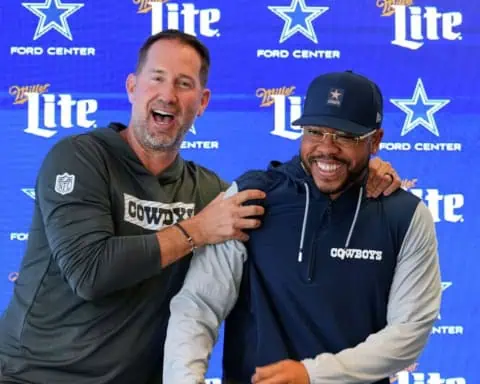
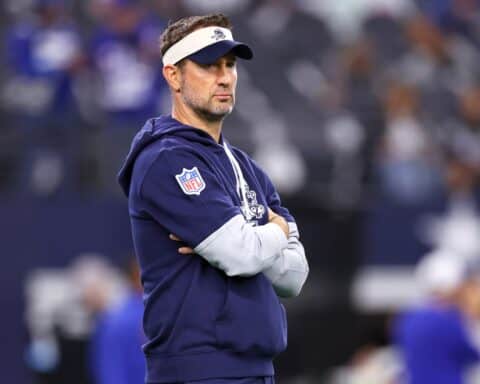
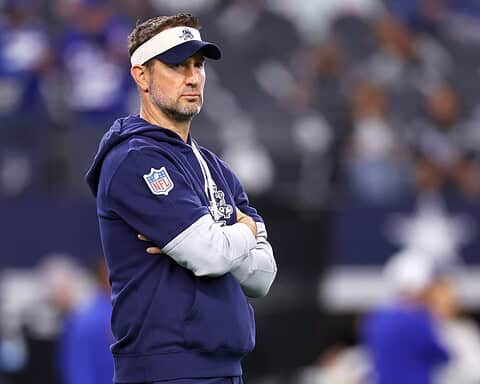
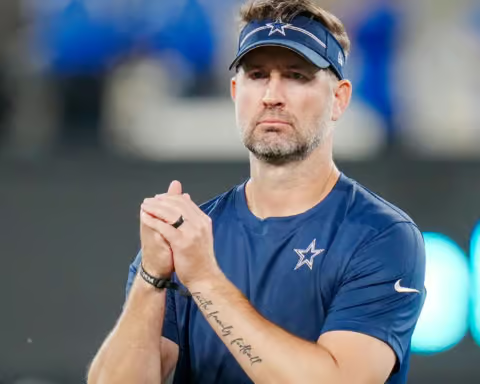
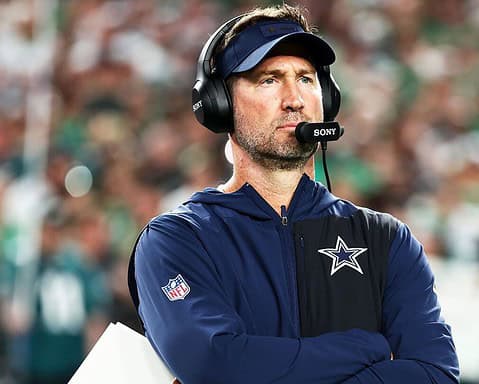
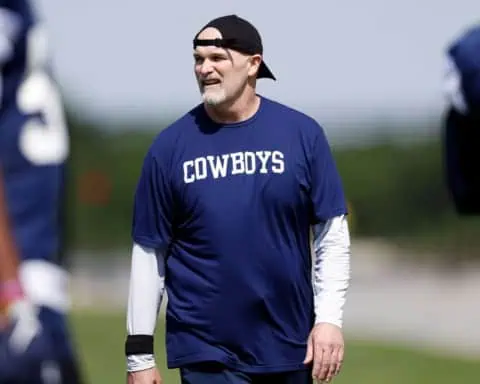
When the Dallas Cowboys confirmed Christian Parker as their new defensive coordinator, the move landed quietly compared to headline-grabbing coaching hires elsewhere in the league.
That understated reception misses the point.
This appointment is not about splash or reinvention. It is about tightening margins, correcting recurring stress points, and modernizing a defense that has looked dominant in stretches yet vulnerable when the stakes rise.
The Cowboys are not abandoning the aggressive identity that defined recent seasons. Instead, they are betting on precision over volume, and teaching over intimidation.
Why Dallas pivoted now rather than later
Defensive continuity has been a priority in Dallas since the roster was built around speed, versatility, and disruption.
Yet the same issues surfaced repeatedly in high-leverage games: coverage busts against condensed formations, predictable pressure looks on third down, and a tendency to lose structural discipline when opponents forced the defense to play patiently.
Those problems are not solved by more talent.
They are solved by coaching clarity.
Parker’s hiring reflects an internal assessment that the defense had reached a ceiling under its previous framework, particularly against playoff-caliber quarterbacks who punish schematic repetition.
How this affects NFL sports betting considerations
For those involved in NFL sports betting, Parker’s arrival introduces a variable worth monitoring early in the season. Defenses undergoing schematic refinement often outperform expectations against the spread before bookmakers adjust.
Dallas may not post elite raw defensive stats immediately, but situational improvements can influence totals, live betting markets, and matchup specific wagers.
Markets involving defensive consistency, second-half performance, and opponent passing efficiency are particularly sensitive to coaching changes.
Bettors using platforms allowing for bank transfer deposits may find value in tracking how Dallas performs against motion-heavy offenses and veteran quarterbacks during the first six to eight weeks.
Christian Parker’s coaching profile goes deeper than his resume
Christian Parker is not widely known outside coaching circles, but his reputation inside the league is stronger than his public profile suggests.
His background is rooted in defensive backs coaching, where the margin for error is smallest and accountability is unavoidable. Corners and safeties expose scheme flaws immediately.
That environment shapes how a coordinator thinks.
Parker is regarded as a technician rather than a motivator-first coach. His practices are structured around communication speed, route recognition, and post-snap decision-making.
That emphasis matters for a Dallas roster built on reactive athletes rather than static specialists.
What Parker believes defensively and where he draws hard lines
Parker’s philosophy is not defined by a single coverage or front. It is defined by problem-solving.
He prefers man principles with zone answers built in, particularly against bunch sets, motion-heavy offenses, and tight splits.
Rather than calling pure Cover 1 or Cover 3 repeatedly, he layers responsibilities so that defenders can trade assignments without blowing leverage.
Examples include match-zone concepts, pattern-matching coverage rules, and late safety rotation designed to bait quarterbacks into throws that look available pre-snap but disappear after the drop.
Crucially, Parker is less tolerant of freelancing than his predecessor.
Explosive plays conceded by defensive backs guessing routes rather than playing technique were a recurring issue in Dallas.
Expect that tolerance to drop sharply.
How this differs from the successful Dan Quinn era in practice
Under Dan Quinn, the Cowboys defense thrived on speed and intimidation. Wide alignments, fast edges, and early down pressure overwhelmed weaker opponents. Against elite offenses, that same approach sometimes became predictable.
Parker’s difference is subtle but important. Where Quinn leaned into repetition and execution, Parker leans into variation and sequencing.
Pressure will still come, but not always from the same launch points.
Coverage shells will look familiar before the snap and shift immediately after.
This is not a rejection of Quinn’s work. It is a refinement aimed at reducing exposure when Plan A stops working.
Personnel fit tells the real story of Parker’s plan
Dallas already has the kind of roster Parker prefers: athletes who can handle responsibility without constant sideline correction.
The front seven provides enough disruption to avoid heavy blitz rates, which allows the back end to stay structurally sound.
The secondary, in particular, becomes central to this defense.
Corners are expected to play with disciplined leverage rather than chasing interceptions. Safeties are tasked with disguise and communication first, range second.
This approach suits a defense that wants to win late downs rather than dominate early ones.
The secondary under Parker: fewer gambles, fewer breakdowns
For defensive backs, Parker’s system demands mental sharpness. Players such as Shavon Revel Jr. will still be allowed to play aggressively, but aggression must be earned through alignment and leverage, not anticipation alone.
Dallas struggled last season with explosive completions off miscommunication, particularly against motion and stacked releases.
Parker’s emphasis on coverage rules rather than coverage calls directly addresses that weakness.
Expect fewer interceptions born from gambles, but also fewer touchdowns conceded because two defenders expected different outcomes.
Situational defense becomes the measuring stick
One of Parker’s defining traits is how he evaluates defensive success. Yardage totals and sack numbers matter, but situational outcomes matter more.
Third-and-medium, red-zone snaps, and end-of-half drives are where his defenses are judged internally.
Dallas has been excellent on early downs and inconsistent late in sequences.
Parker’s install prioritizes clarity under pressure, which should translate to better results when opponents are forced to execute precisely rather than play fast.
What this realistically means for the upcoming season
The Cowboys defense is unlikely to look radically different in September.
The changes will show up in how opponents struggle to identify tendencies by November. Fewer coverage busts, fewer easy throws against pressure, and better late-game composure are the realistic benchmarks.
If the defense improves without sacrificing its turnover potential, Dallas becomes harder to beat in playoff environments where patience and discipline decide outcomes.
Why this hire signals trust in coaching, not just talent
The Cowboys did not hire Parker to overhaul the roster or chase trends. They hired him to extract more from what already exists.
That choice reflects organizational belief that their defensive issues were structural, not personal.
In a league increasingly defined by offensive adaptation, the Cowboys have chosen a coordinator whose strength lies in anticipation and correction rather than confrontation.
If that approach holds under postseason pressure, this hire will be remembered as one of the quiet but decisive moves of the offseason.
Was this helpful?