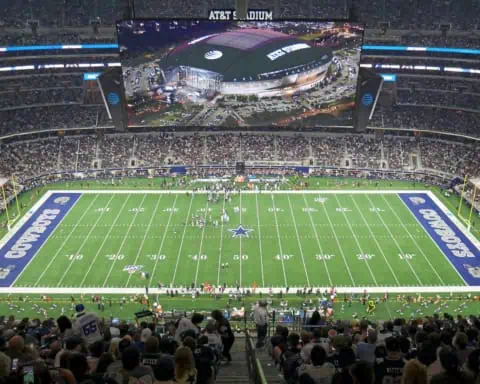
An announcement on the Cowboys’ website on August 26, 2015, put a fantasy sports company inside AT&T Stadium, at field level. The long-term deal with DraftKings came with a lounge placed at the gateway visiting players use when they leave their locker room, open to select suite and club ticket holders.
Jerry Jones Jr., the team’s chief sales and marketing officer, called it “a natural partnership.” Neither side disclosed the money or the length.
The room wasn’t one of a kind. CBS DFW reported that summer that DraftKings had set up similar lounges with the Patriots at Gillette Stadium and the Chiefs at Arrowhead.
What set Dallas apart came two months later, when the owner’s own money became part of the story and fans learned that league rules treated a club and the man who owns it as two different investors.
Eleven years on, the team’s business side reads like a map of how the NFL and the companies around it changed. The league went from holding those firms at arm’s length to signing them as official partners, and DraftKings went from a lounge in Arlington to licensed operations in two Canadian provinces.
That happens to be where plenty of Cowboys fans live, if you take the owner at his word.
Cowboys Owner Jerry Jones Kept a Personal Stake the NFL Barred Clubs From Holding
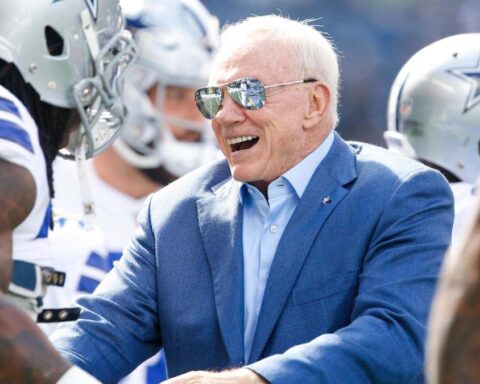
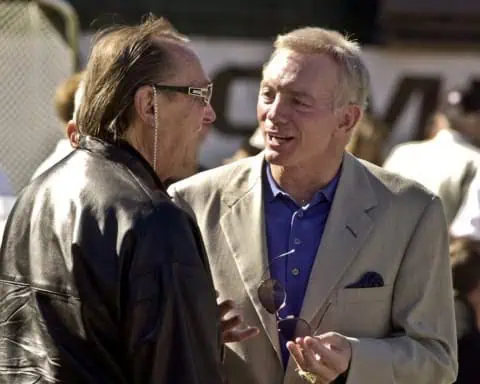
Dallas lost to the Giants in East Rutherford on October 25, 2015, and minutes after the final whistle, the owner was defending an investment.
Daily fantasy was under fire that month. A DraftKings employee had won $350,000 in a FanDuel contest, and New York’s attorney general and a federal prosecutor in Manhattan had started looking into both companies, ABC7 New York reported on October 26. Jones didn’t back away.
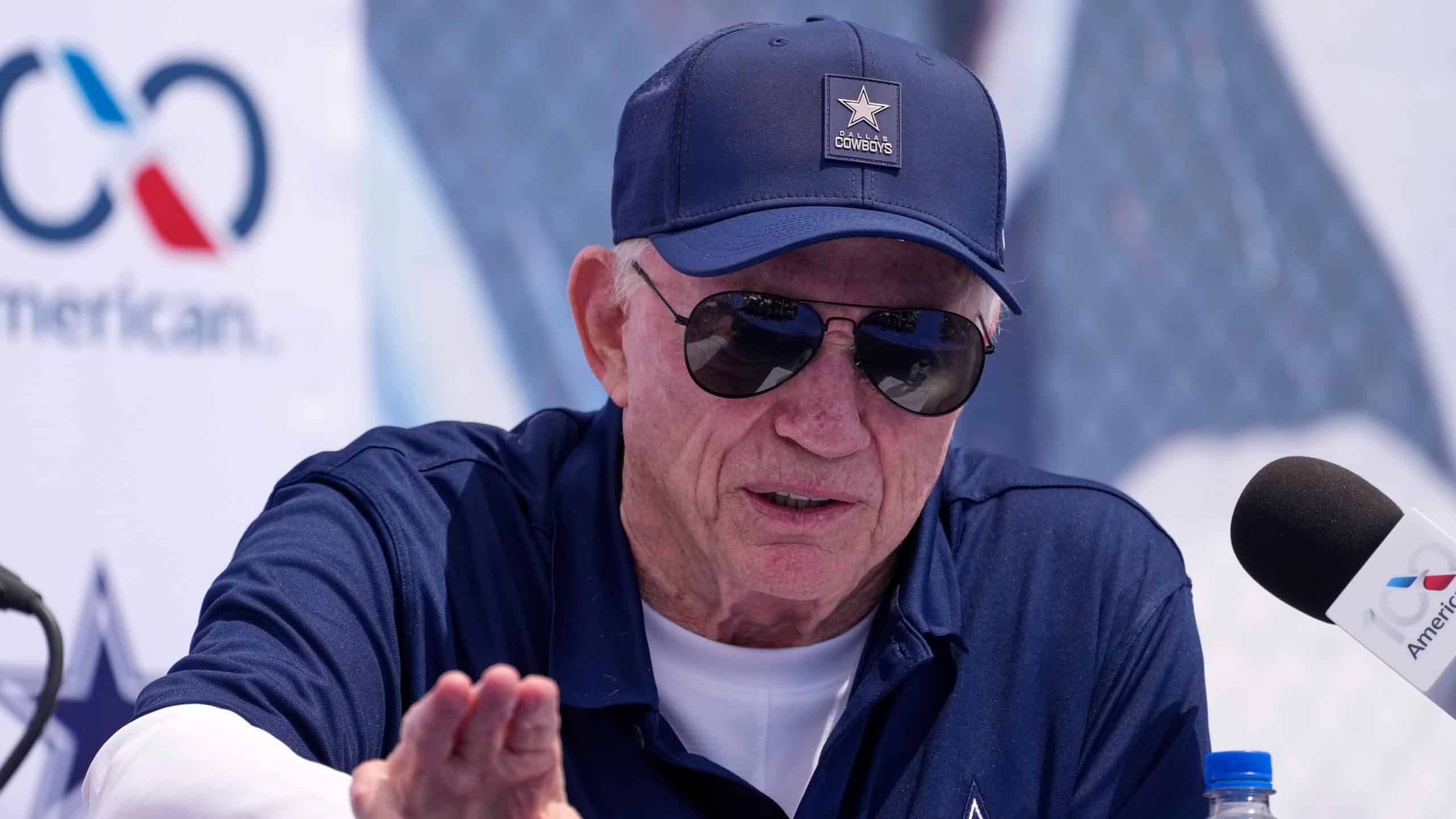
“From my perspective, anything that follows the rules, that causes and creates more interest and more fan participation, I’m really for,” he said.
He called himself “a supporter,” summed up his position as “put your money where your mouth is,” and argued that neither fantasy site could “compromise our players on the football field because it’s all fantasy.”
Then he drew the line he cared about most, insisting that fantasy play had “no bearing” on what happened between the lines.
The rule he leaned on was a narrow one. NFL teams weren’t allowed to invest in daily fantasy companies, but their owners were, and the Kraft Group, which owns the Patriots, held a stake as well.
Players had a limit of their own, since they could enter contests but couldn’t accept a prize above $250. Neither ownership group disclosed what its share was worth. To the league, a club buying in was out of bounds, and an owner buying in was a private matter.
The NFL Signed DraftKings as a League Partner in 2019, Then Again in 2021
Within four years, the league had shifted. On January 3, 2019, it named Caesars Entertainment its first official casino sponsor, in a deal that left out sports betting and daily fantasy, and Fortune noted that the NFL had never before officially recognized gambling.
That January deal came eight months after the Supreme Court handed each state the choice on sports betting.
DraftKings came next. In September 2019, the league signed it as its first official daily fantasy partner, and chief executive Jason Robins called it “a defining moment in the industry” in the announcement on NFL.com.
A company that had once signed deals club by club now held one covering the whole league.
The biggest step landed on April 15, 2021, when the league named Caesars, DraftKings and FanDuel its first official sports betting partners, Sports Video Group reported, with Caesars keeping its casino sponsorship.
Less than six years after that postgame defense in New Jersey, the company held a league-wide partnership in the category the NFL had kept furthest away for nearly all of its history.
The Cowboys’ 2015 Partner Gave Up Fantasy Contests to Launch in Ontario
Canada was the next market, and the company’s entry there came with an irony for anyone who remembered the lounge in Arlington.
Six weeks after Ontario let private online operators in on April 4, 2022, DraftKings shut its daily fantasy contests to Ontario users at 10 a.m. Eastern on May 17, Sports Betting Dime reported, because the province’s regulator put paid fantasy contests under the same rules as sports betting. Its sportsbook and online casino went live there the next day.
Robins called the launch, in remarks iGB reported, “a significant milestone in our expansion efforts as we reach nearly 40 percent of Canada’s total population.”
Alberta came next on July 13, 2026, as the company’s second province, and in results for the second quarter, released August 6, the company said it was now live in provinces representing about 51 percent of the country’s population.
The company behind the Arlington lounge now works under two provincial systems that don’t match.
A page of Canadian online casino market coverage explains how they differ: private operators in Ontario register with the AGCO and sign an operating deal with iGaming Ontario, while Alberta’s need AGLC registration plus an Alberta iGaming Corporation contract, and the page lists 19 as Ontario’s minimum age and 18 as Alberta’s.
Dallas Won Its 1995 Sponsorship Fight With the NFL on Jones’s Terms
The lounge deal rested on a habit the owner formed 20 years earlier. In 1995, the league held official deals with Coca-Cola and Reebok, and Jones signed his own with Pepsi and Nike, worth an estimated $40 million, through Texas Stadium rather than through the club, ESPN’s Todd Archer wrote in 2017.
Routing them through the stadium kept that money out of the league’s revenue-sharing pool. He didn’t hide it, either, and stood on the sideline at the Monday night season opener against the Giants with Nike chairman Phil Knight.
The league answered in court. NFL Properties sued Jones, the Cowboys and Texas Stadium in September 1995, seeking $300 million, and he countersued for $750 million, according to Archer. “I am well advised and sensitive to playing by the rules.
There is no way that I’m in violation of any NFL rules,” he said at the time. Both suits were dropped a year later, and Archer wrote that the owner came out ahead, because the case had shown other clubs running stadium deals with sponsors the league hadn’t signed.
That’s the owner Inside The Star’s Cody Warren described in a 2025 column asking whether Jones is holding the Cowboys back or lifting them up, which credited him with pioneering in-stadium sponsorships and pushing the league toward team-controlled marketing rights.
A club that controls its own sponsor inventory has room to sell a field-level lounge on its own terms, and in 2015 Dallas sold one to a fantasy brand.
The Cowboys Still Top Forbes’s NFL Valuations, Now at $17 Billion
The franchise behind that control keeps getting bigger. Forbes’s Dallas Cowboys team profile, calculated in September 2026, puts the franchise at $17 billion, with $1.3 billion in revenue and $677 million in operating income for the 2025 season.
The profile says Dallas has sat at No. 1 on its NFL valuations list since 2007, became the first team to pass $1 billion in revenue in 2021 and has led its list of the world’s most valuable sports teams since 2016.
Inside The Star covered the same rankings in May 2021, when Forbes put the team at $5.7 billion. That story quoted Forbes on where the value came from: Jones bought the club in 1989 for $150 million and added a stadium stacked with luxury boxes, The Star in Frisco, a merchandising business and an equity stake in the stadium management company Legends.
It also cited record operating profits of $425 million on revenue of $980 million in the 2019 season, numbers the 2025 season beat on both lines.
That growth, from $5.7 billion to $17 billion in five years, sets the price of standing next to the star on the helmet.
Forbes puts gate receipts, club seats included, at $140 million, about a tenth of revenue, so most of the money comes from somewhere other than the ticket office.
The Cowboys Have the NFL’s Biggest Canadian Fan Base, Jones Claimed in 2016
The owner has a theory about where some of that audience lives. After a close game in Minnesota on December 1, 2016, he told the radio show GBAG Nation that Cowboys fans had packed the building. “Coming in and leaving, our fans were everywhere,” he said, CBS Texas reported.
“A lot of them came from Canada, many from Canada.”
Then he went bigger. “There’s no doubt in my mind that we have the most fans in Canada for the NFL,” he said.
He offered nothing to back it beyond what he and the Vikings’ staff had noticed around the stadium that night.
If he’s right, a share of the audience behind that $17 billion valuation lives in Ontario and Alberta, both provinces DraftKings has entered since 2022. That province-by-province page came from Bonus.com, which is on X too: Bonus.com on X.
An owner who sold his own sponsorships over the league’s objections in 1995, then kept a fantasy stake in 2015 that his club wasn’t allowed to hold, doesn’t need a census to make that pitch.
He knows what a fan base across the border is worth to the next company asking for a room at field level in Arlington.
Was this helpful?